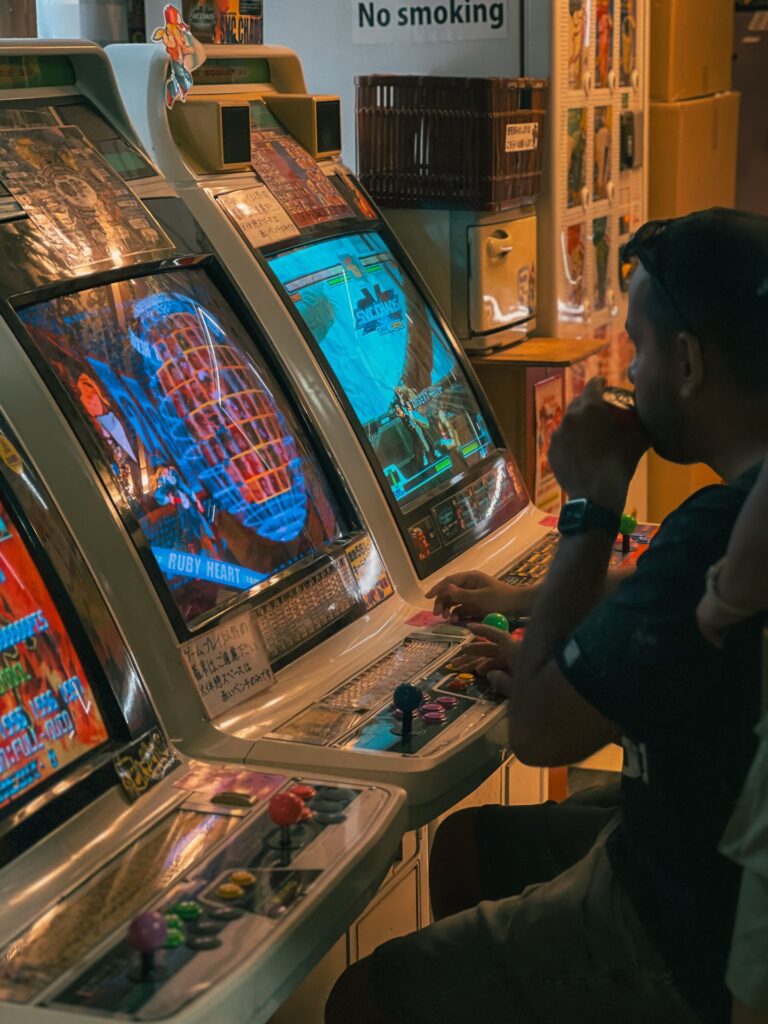
A visitor entering a movie theater and a visitor entering an arcade are looking for different things, but they encounter some familiar signals. Both spaces promise an experience beyond everyday life. A theater advertises a world through a poster, a title and an image of its characters. An arcade cabinet uses artwork, a screen and controls to invite someone to try an action. In each case the invitation begins before the entertainment itself.
The connection is more interesting than a history of films turned into games. It is a history of how screen entertainment developed its own public vocabulary, how audiences learned to recognize fictional worlds, and how playing alongside other people became a distinctive kind of spectatorship.
The machine as a miniature attraction
An arcade cabinet has to explain itself quickly. Someone approaching it may not know the rules or even the subject. The image on the machine, the shape of the controls and a demonstration on the screen can help that person understand what is being offered. A successful cabinet combines those elements into a physical object that attracts attention from across a room.
Cinema advertising faces a comparable challenge. A poster cannot reproduce two hours of dramatic action. Instead, its designer selects a recognizable situation, a striking figure or a memorable color scheme. The cabinet offers a similar reduction, but its promise must ultimately be fulfilled by a playable activity. A beautiful image is not enough if the relationship between the controls and the screen remains confusing.
This distinction matters when comparing the two industries. Movie promotion can invite curiosity about events that will unfold in a fixed order. Arcade promotion must also communicate something about what a participant will do. The interface is part of the entertainment, not just a means of reaching it.
Science fiction on both sides of the screen
Early electronic games found a useful visual vocabulary in outer space. A small set of moving shapes could represent a ship, an obstacle or an approaching threat without requiring elaborate backgrounds. A black screen that might otherwise have looked empty could become a vast fictional environment.
The Strong National Museum of Play records an especially direct crossing between the two media in its entry on Computer Space: a cabinet appeared in the 1973 science-fiction film Soylent Green. In that setting an actual electronic game served as an object from an imagined future. The physical design of the machine helped make the fictional setting recognizable.
The relationship also works in reverse. An audience familiar with cinematic spacecraft, alien encounters and futuristic machinery can interpret a simple game screen through associations learned from other media. The game need not reproduce a particular movie to benefit from that shared visual culture.
When recognizable shapes become characters
Not every important game depended on a science-fiction premise. The museum’s account of Pac-Man describes a character that became recognizable far beyond the original arcade context. A simple silhouette proved capable of carrying a cultural identity without the dialogue, detailed costumes or facial expressions associated with conventional film stars.
That economy of design is worth considering alongside the way memorable screen characters are constructed. A movie audience may recognize someone by a costume, an entrance or a gesture. A game character can likewise become identifiable through movement and shape. The difference is that the player may spend the experience repeatedly performing the very action that defines the character.
This is one reason a screen personality does not have to become more visually realistic to become more expressive. A clear relationship between appearance and behavior can be just as important. The character that the audience remembers is often the one whose actions, rules and visual identity reinforce one another.
Playing and watching in the same room
Arcade play creates an unusual arrangement between performer and spectator. One person operates the machine while someone else observes. The spectator may be learning the rules, waiting for a turn or simply following the unfolding attempt. A near miss can become entertaining even for someone who never touches the controls.
Unlike a film screening, however, the outcome of a particular session is not guaranteed to be identical the next time. A participant may choose another route, react more slowly or discover a different technique. The same situation can therefore produce a short drama whose details are partly determined by the person playing.
This helps explain why shared digital entertainment need not require everybody to be controlling a screen simultaneously. Conversation, observation and taking turns can give a simple activity a social dimension. The audience and performer roles may change repeatedly within a single visit.
The importance of rules rather than plot
A cinema audience generally asks what will happen next in the story. An arcade player may instead ask what will happen if a particular move is attempted. Those questions sound similar, but they involve different kinds of uncertainty. One concerns an authored sequence; the other concerns the behavior of a system.
The museum’s history of Asteroids provides an example of how distinctive gameplay can emerge from the arrangement of a few recognizable elements. The pleasure of a space-themed game is not necessarily the discovery of a detailed fictional biography. It can come from learning movement, anticipating obstacles and reacting to changing circumstances.
Many interactive digital experiences depend on this balance between intelligible rules and unpredictable situations. A participant should be able to understand the consequences of an action while remaining curious about what will happen in the next moment. The principles of clear visual communication learned from cinema can support that balance, but they cannot substitute for coherent interaction design.
Reading the visual evidence
For a film historian, comparing a theater poster with an arcade cabinet can reveal both shared conventions and differences in purpose. Look first at the main image, then at secondary figures, typography and the position of any instructions. Ask what the object promises to a newcomer and whether a person already familiar with the entertainment would read it differently.
Photographs of the original machines are especially useful because they preserve details that a screenshot omits: the scale of the cabinet, the placement of the controls and the relationship between decorative artwork and the playable screen. A photograph of an arcade as a whole can also document how the machines were experienced together.
Such material should be interpreted carefully. A contemporary photograph of a surviving cabinet is evidence of its condition when photographed, not necessarily a record of the room where it originally stood. Catalog information and documented dates help separate the history of a game from the later history of its preservation.
Two forms of screen culture
Cinema and arcade games have never needed to become identical to influence one another. Their strongest connections lie in the ways they communicate character, setting, movement and expectation. Both have learned to make a fictional possibility recognizable in a few seconds, and both can turn a visit to a public entertainment space into a lasting memory.
The distinction remains valuable. Films make meaning through a sequence of images and sounds that a filmmaker arranges. Games also ask what the audience can do with the situation presented. Understanding that difference makes it possible to appreciate arcade machines not simply as miniature movies, but as distinctive cultural objects with their own visual language and social history.